Design Context
When the University of Minnesota shifted to remote instruction in 2020, I chose to design this course as fully asynchronous rather than replicating a synchronous classroom via Zoom. The decision was deliberate: asynchronous delivery reduced technological barriers for students with unreliable internet, accommodated varied schedules, and — more importantly — allowed me to design each week's content as a self-contained learning unit rather than a series of live meetings. The course enrolled a mix of traditional undergraduates and returning adult learners, which further supported a flexible, self-paced structure.
Module Architecture
The course was organized into weekly Canvas modules, each unlocking on a fixed schedule (Wednesdays at 5:30 PM) and closing when the next module opened. This created a consistent rhythm: students knew exactly when new material would appear, what was expected each week, and when deadlines fell. Every module followed the same internal pattern:
Capping the workload at two graded assignments per week was a conscious design choice. Asynchronous courses carry a risk of overwhelming students who lack the pacing cues of a live classroom. A predictable, bounded workload keeps the cognitive load on the content itself rather than on navigating the course structure.
Narrated Slide Lectures
Rather than recording a face-to-camera lecture, I produced narrated video lectures by screen-recording slide presentations in OBS while recording audio separately in Audacity. This split-source approach gave me precise control over audio quality and pacing independent of the visual track. I edited the final lectures in Final Cut Pro, integrating historical images, primary source video sourced from YouTube and Kaltura, and other media examples directly into the presentation.
Media Sourcing & Production
Each lecture integrated visual assets drawn from multiple sources — archival photographs, documentary footage, news clips, and educational video hosted on Kaltura. These weren't decorative; each visual element was selected to serve a specific function in the lecture's pedagogical arc, whether grounding a historical claim in primary evidence or illustrating a contemporary application of a theoretical concept.
Reading Responses as Formative Assessment
Weekly reading responses asked students to summarize each author's argument, evaluate the evidence, and connect readings to each other and to broader course themes. This isn't just comprehension checking — it's a structured exercise in synthesis and critical analysis, building the exact skills the final paper demands.
Timed Module Release
Modules unlocked and locked on a weekly schedule, ensuring all students moved through the material on the same timeline. This maintained a sense of cohort progression despite the asynchronous format and prevented students from falling behind without realizing it — a common failure mode in self-paced courses.
Low-Stakes Variety
Weekly assignments alternated between quizzes, written reflections, and paper components. Varying the format keeps engagement up and lets students demonstrate understanding in different ways, while the consistent two-per-week cap prevents assignment fatigue.
Accessibility in Practice
Each narrated video lecture was accompanied by a manually edited transcript — auto-generated captions were corrected for accuracy and posted alongside the video as a standalone text resource. Stripped-down versions of the lecture slides were also published after each module opened, giving students a parallel reference that didn't depend on video playback.
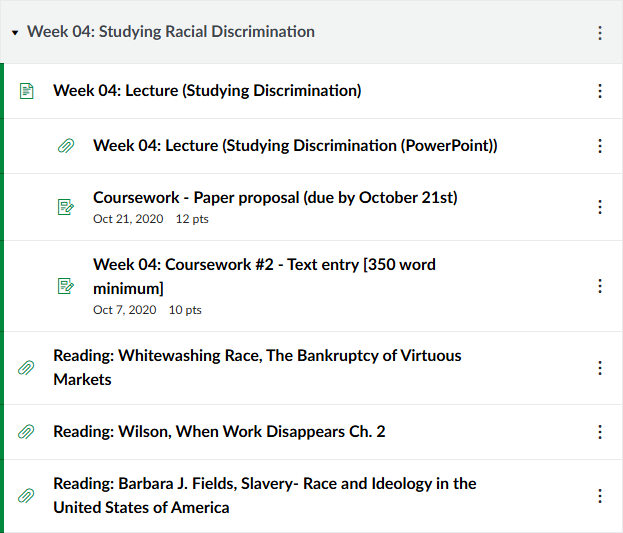
Week 04 module in Canvas. The module structure follows the consistent pattern described above: narrated lecture, followed by two graded assignments (the paper proposal and a reading response), with assigned readings listed below. The paper proposal checkpoint appears here at Week 4 — early enough to catch unfocused topics before students invest significant writing time.
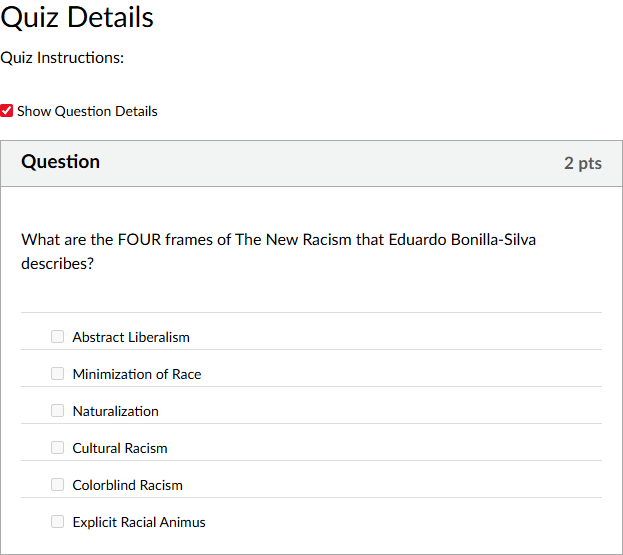
Week 04 quiz question example in Canvas. The quiz question example is a straightforward question based on both the information gleaned from the reading and also reiterated in the lecture.
Scaffolded Assessment: The Course Paper
The primary summative assessment — an 8–10 page research paper — was deliberately broken into staged checkpoints distributed across the semester. Each stage received instructor feedback, and students were required to submit a written explanation of how their revision addressed prior comments. This design ensures the final paper reflects iterative improvement rather than a single high-stakes attempt.
Paper Proposal (5%)
One-page proposal identifying research topic, question, and goals. Assessed on feasibility and connection to course themes. Functions as an early checkpoint to catch unfocused or overly ambitious projects before students invest significant time.
Full Draft (10%)
Complete rough draft submitted for instructor and TA feedback. This satisfies the writing-intensive course requirement for at least one revision cycle and gives students substantive commentary on argument structure, evidence use, and writing quality while there's still time to act on it.
Final Paper (20%)
Revised final submission with required reflection on how feedback was incorporated. The reflection component makes the revision process visible and intentional rather than cosmetic.
Learning Outcomes
The course was built around two primary outcomes: (1) developing critical thinking skills — the capacity to evaluate claims, assess evidence quality, and identify faulty reasoning — and (2) developing critical writing skills — the ability to construct and support an original argument in sustained prose. Every weekly assignment and the scaffolded paper sequence were designed to advance these two outcomes in tandem.